

Have you ever let a membership or subscription lapse, or stopped buying a product after years of what looked like loyalty? I have. A few years ago, I switched the airlines and hotel brands I had used for more than a decade because a better offer came along. I have done the same with memberships, subscriptions and even chocolate, although my search for the best chocolate in every city I visit is probably never going to end.
From the organization’s point of view, my behavior looked like loyalty right up until the moment it stopped. I kept buying, renewing and returning, which are the signals many organizations track most closely. Those actions were real, but they did not explain why I stayed or what might persuade me to leave. Behavior can show that a relationship continues, but the reason behind that behavior tells us how durable the relationship may be.
What the Poll Results Showed
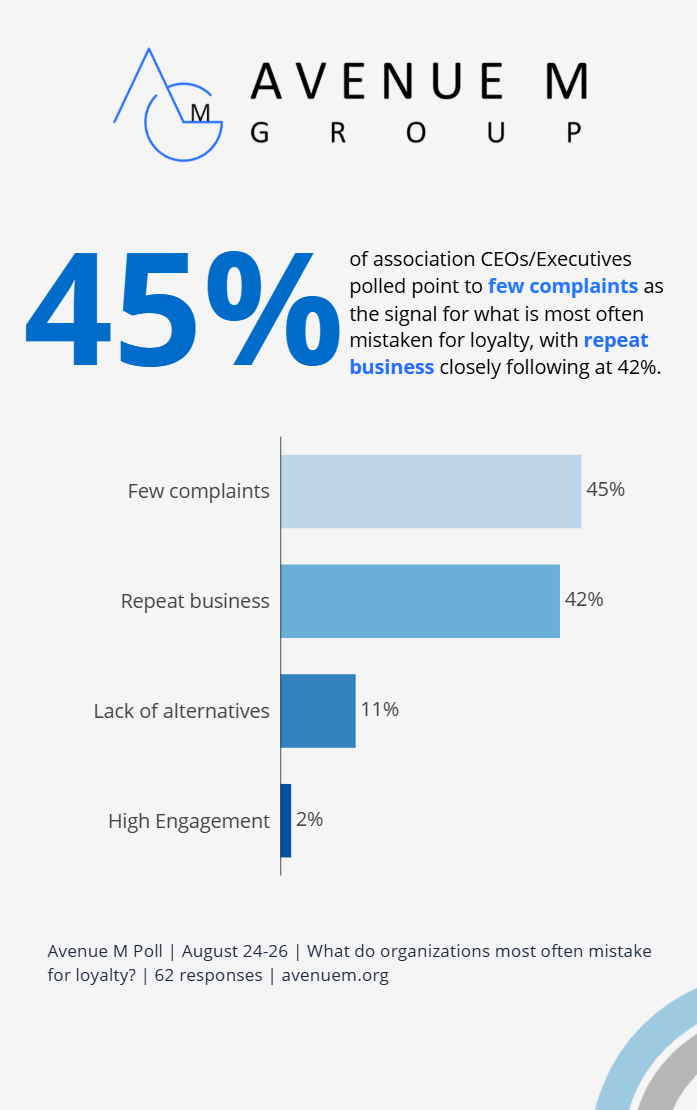
This month, Avenue M asked executives through our text poll and LinkedIn, “What do organizations most often mistake for loyalty?” All four response options can be valid, which is what made the question difficult. Among 62 respondents:
- 45% selected few complaints
- 42% selected repeat business
- 11% selected lack of alternatives
- 2% selected high engagement
Few complaints received the largest share of the vote, followed by repeat business. The results reveal how cautious leaders have become about interpreting visible behavior without understanding what is behind it. A repeat customer, a membership or subscription renewal, or frequent participation or years without a complaint can look reassuring, but none of those signals explains why the relationship continues. That missing context may be the most important part.
Repeat Behavior Tells Only Part of the Story
Repeat business is easy to count, which may be one reason organizations give it so much weight. Yet a renewal, purchase or return visit does not reveal whether someone feels a strong connection, prefers the familiar option, has not considered another choice or simply has no reason to change yet. In “Customer Loyalty Is Overrated,” A.G. Lafley and Roger L. Martin make a related argument that what companies interpret as loyalty may be habit. The distinction matters because a habit can look dependable until something interrupts it.
My airline and hotel decisions are a good example. More than a decade of repeat business could have been entered into a dashboard as evidence of loyalty, but a better offer exposed the limits of that conclusion. I had a pattern, and the brands benefited from it for years. They did not necessarily have a relationship strong enough to withstand a more appealing choice.
Daniel Tadesse, PMP, CAE, Director of Member and Customer Services at the American Urological Association, shared a similar experience in the LinkedIn conversation. After a decade of repeat business with his preferred airline, one poor service experience caused him to switch. Until that happened, the airline may have seen a loyal customer with little reason to question the relationship. Daniel’s story shows how repeat business and few complaints can exist right up until the moment someone leaves.
Jamie Beaulieu, SVP, Executive Education & CEO Programs at the American Bankers Association, proposed a data point that would test the same assumption from a different angle: compare your repeat attendees against your loudest complainers and see how much the two groups overlap. Some people show up year after year because attendance is how they maintain their accreditation, not because the organization has earned their commitment. As Jamie put it, that pattern does not mean they would remain loyal if another avenue existed to achieve the same result. The repeat business in the dashboard would have been real, but it was measuring obligation rather than loyalty.
Each Signal Can Be Misread
High engagement provides more information than a purchase alone, and some participants argued it deserves far more weight than the poll results gave it. Jamie made the case that engagement, along with measures like Net Promoter Score, speaks more directly to loyalty than repeat business does. In her view, the people who continue to invest in the partnership are the true believers and cheerleaders, and they benefit from that investment by taking a seat at the table and helping drive the organization’s direction. Jeff Morgan, President & CEO of the Club Management Association of America, pointed to NPS as well, describing loyalty as the point at which members become your best ambassadors to non-members. Even so, activity still needs context. Frequent participation may show that the organization is valuable to someone at that moment, but it does not reveal the source or strength of that value, or what would happen if the person’s needs changed or another organization offered something more relevant.
Few complaints may be the most dangerous signal to misread because silence can mean several different things. A person may be satisfied, may believe speaking up will not change anything or may have already begun to disengage. Lack of alternatives creates a different problem because continued business may reflect limited choice rather than commitment. In each case, the visible behavior can look reassuring while the reason underneath it remains unknown.
Ask Questions That Expose the Reason
Organizations need more than a record of what people did. They need to understand what the relationship provides, what keeps someone choosing it and what could cause that choice to change. That means asking people why they renewed or returned, rather than treating the action as the answer. It also means listening closely when someone raises a concern, since a complaint may reflect enough investment in the relationship to want it to improve.
Daniel offered a more demanding definition of loyalty. He described it as the point at which a customer is invested enough to become an advocate for the organization or brand. Gonzo Schexnayder, Product Management Executive at the American Society of Anesthesiologists, described the same threshold in nearly identical terms: loyalty arrives when a member becomes a vocal champion for your organization, product or service. Carla Lochiatto, Director, CSO Center for Leadership & Development at ASIS International, offered a formula that ties the threads together, defining real loyalty as repeat business plus engagement plus passionate promotion of the organization and its benefits. Advocacy does not make a relationship impossible to break, as Daniel acknowledged, but it may reveal a stronger bond than quiet retention. That raises a better question for organizations: Are people staying because the relationship matters to them, or are they simply staying?
The more revealing questions may be the ones that make choice visible. What would someone miss if the membership, subscription, product or service disappeared? What would make that person consider an alternative? When a better offer or disappointing experience arrives, what part of the existing relationship still matters enough to influence the decision? Those answers can help an organization distinguish routine behavior from a relationship that has earned another choice.
What Does Real Loyalty Look Like?
The advocacy definitions that Daniel, Gonzo and Carla each arrived at give us a useful place to start. Advocacy suggests that someone is willing to put their own reputation behind the relationship instead of quietly continuing it. Even then, loyalty should not be treated as permanent or unconditional. What does real loyalty look like in your organization, and what have you learned from the people who stayed, spoke up or left?
Additional Resources
“Customer Loyalty Is Overrated,” by A.G. Lafley and Roger L. Martin. The authors examine the role of habit in behavior that organizations may label as loyalty.
“Customer Loyalty Rules for 2026,” by Amy Lanzi. The article discusses recent research on what customers value in loyalty programs and why participation can end.
Sheri Jacobs is a global keynote speaker, author, and CEO of Avenue M Group who helps leaders and organizations rethink the rules, take smarter risks, and create the conditions where bold ideas can thrive. Sheri is an award-winning wildlife photographer and master storyteller who brings her experiences and images to the stage.
Want to be the first to be notified about articles like this? You can learn more about Avenue M’s texting poll service HERE or sign up to participate in future text polls HERE.
Contributors: Sheri Jacobs, FASAE, CAE and Claude.ai
(Image generated by ChatGPT)