

Avenue M sent out a quick poll this week and expected the usual 50+ responses. We got 16. The question wasn’t complicated: Can your team explain in one sentence why someone should join your organization?
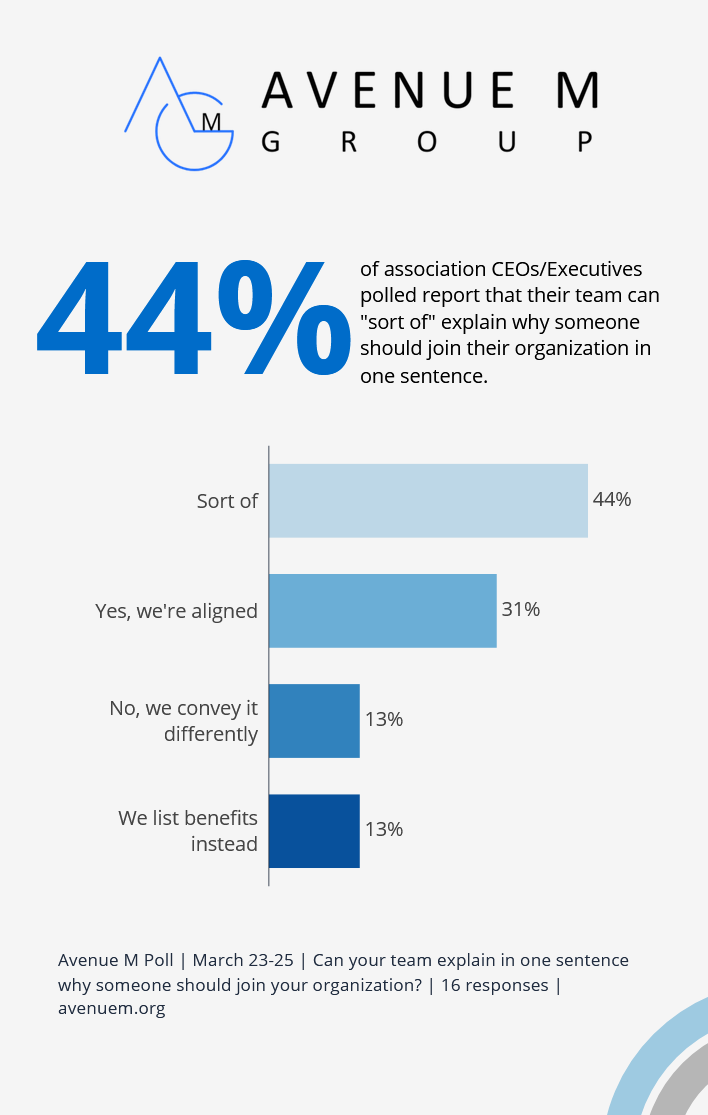
The answers I received were telling. The top response? “Sort of,” with 44% (7 respondents). 31% of respondents (5 people) said, “Yes, we are aligned,” 13% (2 people) said they simply list the benefits they offer, and 13% (2 people) said, “No, we convey it differently.”
The real insight, though? It was in the 34+ people who didn’t respond at all.
As soon as we sent it, I had a hunch the silence might be the story. Because that question, simple as it sounds, is not actually easy to answer. “One sentence” requires prioritization over completeness, clarity over complexity, and confidence over hedging.
In reality, most organizations are used to explaining their value in paragraphs, slides, or benefit lists. Compressing that into a single compelling sentence is challenging.
It’s also possible that some people skipped it because the question created a moment of discomfort. Not because they didn’t care, but because they weren’t sure. It is easier to skip a question than to confront the possibility that the answer isn’t clear.
Others may have thought, this is marketing’s job or leadership’s job. But if only a few people in the organization can articulate why someone should join, the message isn’t shared. It’s siloed. And when it’s siloed, it’s not nearly as powerful.
Then there’s the harder possibility. What if people didn’t respond because a clear, shared answer doesn’t exist? The problem isn’t that it is buried in a strategy document, it’s just not defined in a way that people can easily communicate.
This is not just a messaging exercise. It is a clarity test. If your team cannot explain in one sentence why someone should join, it is not just hard for them to say. It is hard for others to hear, understand, and believe. Clarity is not a luxury. It is a differentiator. It may also allude to a deeper problem concerning alignment within your organization and its mission.
Yes, different audience segments may need different value statements. Value depends on outcomes, relevance, and what only your organization can provide. But that doesn’t remove the need for clarity. It raises the bar for it.
So, ask your team today: What would you say in one sentence? Then ask a colleague the same question. When they can craft a sentence, this tells you something. When they can’t, this tells you more.
Because this is not about finding the perfect sentence.
It’s about whether you can come up with one at all.
Want to be the first to be notified about articles like this? You can learn more about Avenue M’s texting poll service HERE or sign up to participate in future text polls HERE.
Written by: Sheri Jacobs, FASAE, CAE, AAiP, CEO, Avenue M Group, Author of The Unexpected Power of Boundaries
Image: Sheri Jacobs