

As we reach the end of the year, inboxes fill with out-of-office replies, usually followed by “…but I’ll be checking in periodically.”
So I asked my community: “Are you taking real time off this holiday season?”
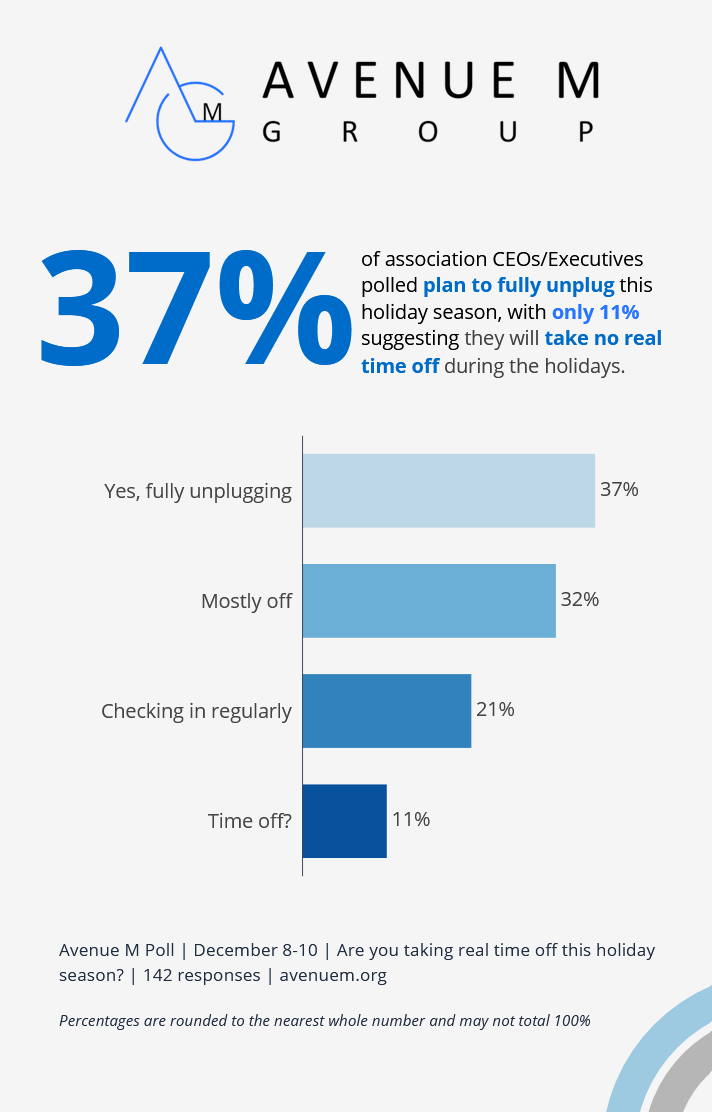 Here’s how 142 respondents, including association CEOs and executives, small business owners, and solo practitioners, answered in the most recent Avenue M quick poll:
- 37% – Yes, fully unplugging
- 32% – Mostly off
- 21% – Checking in regularly
- 11% – “Time off?” (not really)
What I love about these results: There isn’t a right answer. There’s only what’s right for you.
With this data, I created four Holiday Personas:
1. The Full Unplugger (37%)
This group shuts the laptop and leans into the idea that real recovery fuels better thinking for themselves. Research shows that true psychological detachment from work improves performance, well-being, and creativity. Time away isn’t a luxury; it’s part of how they work. As one executive who works for a large medical association shared, “I get my best ideas and plans when I’m not actively thinking about daily work and tasks. Dog walks, long drives, etc.”
2. The “Mostly Off” Group (32%)
The respondents who fall into this profile are off most of the time, with some exceptions: a check-in here, a key client call or member task force meeting there. The difference between “mostly off” and “never really off” is boundaries – deciding when you’re available and sticking to it.
One CEO, who stated they would be “mostly off,” said, “Having time off allows me to recharge my batteries and approach my work refreshed and with a new frame of mind.”
3. The Regular Check-Ins (21%)
For some, light connectivity reduces stress. Knowing work or emails aren’t piling up lets them relax enough to notice new ideas. The key is intentional limits: checking in on a schedule. A small business owner shared, “When you run your own business, it’s part of the role you’ve accepted. If you step away too long, you worry you’ll miss an important email or opportunity. I may leave an out of office message on my email, but I still check-in multiple times a day.”
4. The “Time Off? Not Really.” Group (11%)
Although it may seem counterintuitive, not everyone sees time off as what is needed to get the creative juices flowing. One executive shared, “My activities to refresh and think promote creativity and they can happen in tandem with staying in touch with work.”
While another stated that, “I tend to be highly creative at all times. What time off does give me is perspective on the value of working to live rather than living to work. That makes me more likely to maintain my boundaries around my work time, and in turn makes my work time more effective.”
For many small business owners and solo practitioners, work and creativity are tightly intertwined. They may not step completely away, but they use this season to reset their relationship with work – remembering that life comes first and using that perspective to reinforce boundaries during the rest of the year.
What This Has to Do with Boundaries (and My Book)
In The Unexpected Power of Boundaries: Rethinking the Rules, Risks, and Real Drivers of Innovation, I write that boundaries aren’t fences keeping opportunity out—they’re the edges of your playground. Within those edges, you can take more risks, think more boldly, and recover more fully.
Your holiday plan is a real-life example:
- Full Unpluggers draw a firm line: “I will not be available.”
- “Mostly off” professionals define specific windows and reasons to check in.
- Regular check-in folks set limits on how often and how long.
- The “Time off?” crowd uses this season to reinforce boundaries around work the rest of the year.
All of these can be healthy if they are conscious choices, not default settings.
Three Questions to Shape Your Holiday Boundaries
As you look at the last weeks of the year, ask yourself:
- What do I need most: rest, momentum, or perspective?
Your answer can guide you toward fully unplugging, going mostly off, or designing a light-touch working break. - What season is my organization in?
Are you in a year-end crunch or a natural lull? Your boundaries should reflect your role, your industry’s rhythm, and promises you’ve made to members, clients, or customers. - What will “future me” thank me for in January?
Imagine yourself a couple of weeks into the new year. Will you be grateful you fully unplugged, relieved you stayed lightly connected, or proud that you protected both your work time and your life outside of it?
Especially If You’re a Leader…
If you lead an association, company, or team, your choices send a loud signal. When you say, “Take time off,” but respond to every email within minutes, people notice. When you model clear boundaries – whether that means fully unplugging or checking in in a structured way – you give everyone else permission to do the same.
There’s No One Way to Take “Real” Time Off
Our poll showed four distinct approaches to the holidays, and every one of them can support creativity and performance when paired with clear, self-honoring boundaries.
You don’t need to follow anyone else’s script for rest.
You do need to define your playground: the lines around your time, attention, and energy that will let you enter the new year not just rested, but ready – to lead, to create, and to take more smart risks in 2026.
Want to be the first to be notified about articles like this? You can learn more about Avenue M’s texting poll service HERE or sign up to participate in future text polls HERE.
Contributors: Sheri Jacobs, FASAE, CAE
Image: Sheri Jacobs