

(Image generated by ChatGPT)
For the past few years, much of the conversation about AI in the workplace has focused on adoption. How do we get employees to use it? How do we train them? How do we make people comfortable with the technology so that they will use them to be more efficient?
But the questions I keep hearing from clients, program attendees, and in the research we’ve conducted at Avenue M reveals that the conversation is changing.
This week, I asked a question on LinkedIn and through our text poll focused on what slows down progress or keeps ideas from evolving and moving forward (bottlenecks).
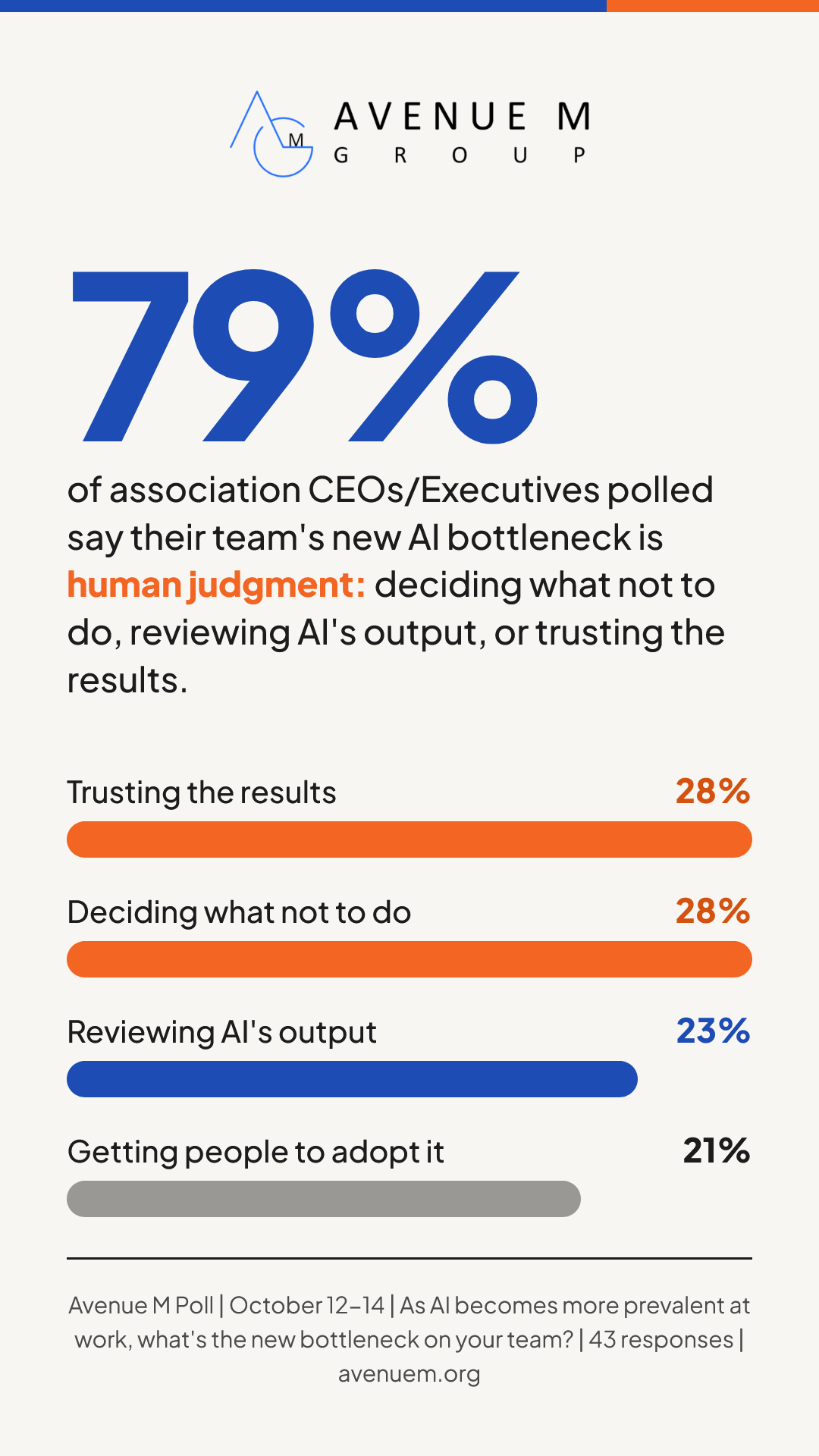
The results from 44 respondents were interesting, particularly because no single answer dominated.
Q. As AI becomes more prevalent at work, what’s the new bottleneck on your team?
- 28% said trusting the results.
- 28% said deciding what not to do.
- 23% said reviewing AI’s output.
- 21% said getting people to adopt it.
And one person added a comment but didn’t vote, adding, “knowing how to use it.”
Since first learning about AI tools and using them at work, I’ve long believed that AI belongs in the middle when making decisions. In other words, human judgment belongs at the beginning and the end when using AI for most tasks. And the results of the poll reveal that 79% identified a challenge that ultimately comes down to human judgment.
If you think about it, AI can generate a report in seconds, produce dozens of ideas, analyze data, and draft a strategy. But someone still has to decide whether the information is accurate, which ideas are worth pursuing, and what deserves the team’s attention. Some people hand off AI generated copy, reports, and spreadsheets without reviewing them for accuracy, context, or relevancy.
In some ways, AI has made it easier to create more work, not necessarily better work. And that’s where I think leaders face a new challenge.
For years, we’ve encouraged our teams to get creative, do more, and find new opportunities. Now we have technology that makes doing more easier than ever. But without clear priorities (or even boundaries), we risk filling our days with activities simply because we can accomplish them faster.
The answer isn’t necessarily more AI training. It’s better clarity about what matters.
That means defining where AI can operate independently, where human review is essential, and which decisions require human judgment. It also means giving people permission to stop doing work that no longer contributes meaningful value.
When everything becomes easier to produce, deciding what deserves to be produced becomes more important.
Of course, this was a small, informal poll, not a representative study. But I think the responses point to something worth discussing.
The next competitive advantage may not belong to the organizations that use AI the most. It may belong to those that are most disciplined about where they use it, what they trust, and what they choose not to do.
We spend a lot of time asking what AI will make possible. Perhaps we should spend just as much time asking a different question: Now that we can do more, what should we stop doing?
Want to be the first to be notified about articles like this? You can learn more about Avenue M’s texting poll service HERE or sign up to participate in future text polls HERE.
Contributors: Sheri Jacobs, FASAE, CAE