

(Image generated by ChatGPT-6 Astra)
It’s Monday morning, and your inbox is already filled with a few messages or reports that were sent by your colleagues but, you suspect, written by AI. Many of the emails are far wordier than they need to be. One email that could have been a few sentences includes four paragraphs and starts by thanking you for your continued partnership.
While the author likely intended to enrich the conversation or streamline their process, the burden ultimately shifts to you. Reading through lengthy, machine-generated paragraphs to uncover the core message takes extra effort. That said, AI certainly offers real benefits, especially when it helps teams deliver polished results more quickly, qualities that leaders have traditionally valued.
In most workplaces it’s still the Wild West, with each employee deciding their own rules. So where do you draw the line, or should you draw one at all? There are clearly a number of pros and cons to using AI. As I write this article in Google Docs, the built-in AI tool frequently makes suggestions on how to finish my sentences.
The question I pose isn’t whether we should or should not use AI in the workplace, but should organizations create a policy regarding where and when to disclose the use of AI or is it just another tool, like a calculator?
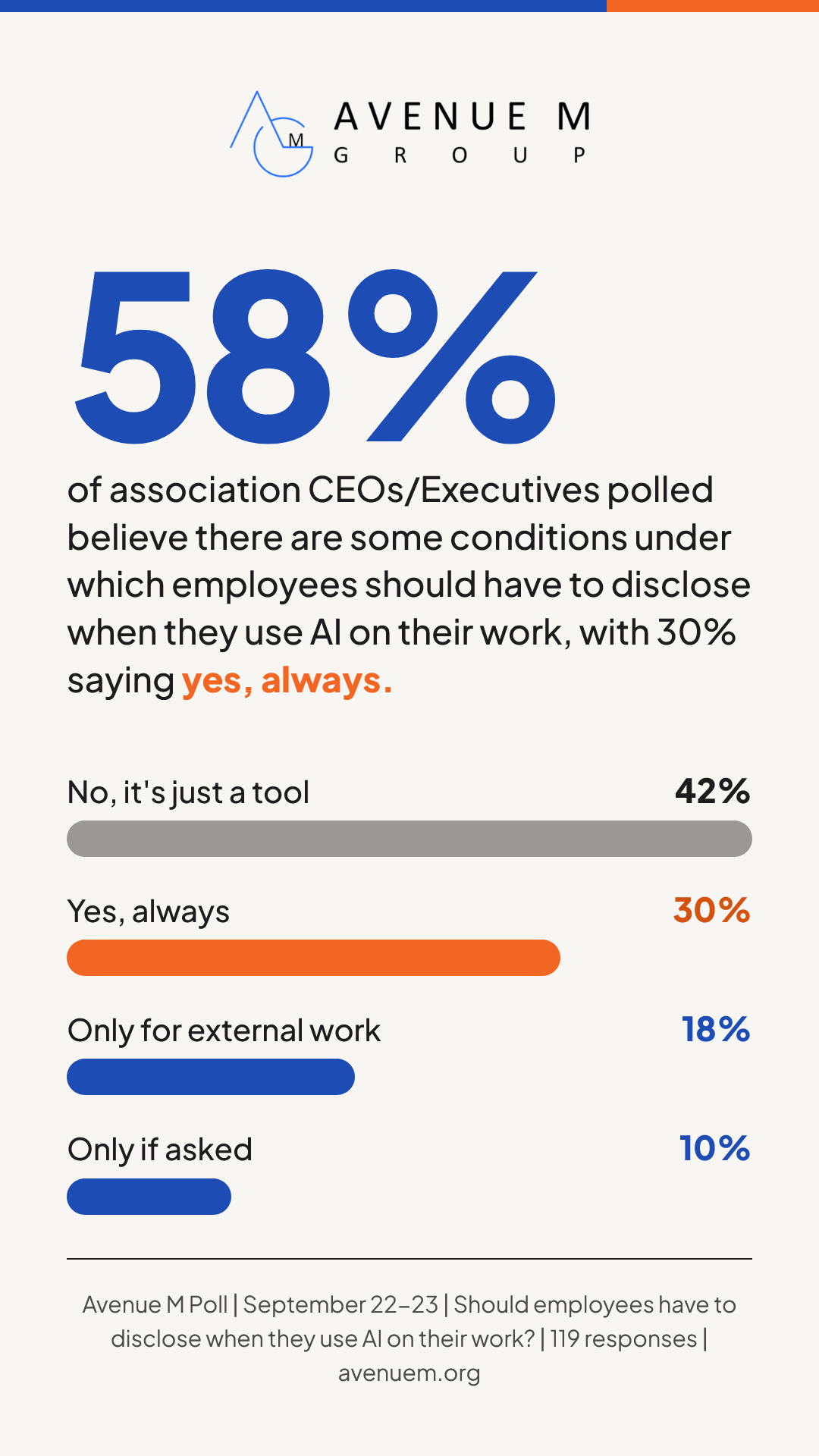
This month Avenue M asked leaders via a text poll and on LinkedIn: “Should employees have to disclose when they use AI on their work?” and we received one of the highest responses to date, with 119 individuals weighing in on the question. When we followed up by asking whether their organizations have a rule, one person answered with three words and an emoji: “Deciding for themselves 😑.”
- No, it’s just a tool: 42%
- Yes, always: 30%
- Only for external work: 18%
- Only if asked: 10%
The largest group sees no need for disclosure, yet combining “always” with “external work” shows nearly a majority (48%) who believe at least some AI use should be stated.
A Very Public Test of the Question
The same debate played out in the national press in August, when The Wall Street Journal (WSJ) published an op-ed by billionaire investor Stanley Druckenmiller challenging Treasury Secretary Scott Bessent’s handling of Treasury yields. When the piece was published, an interesting debate erupted. Rather than discussing the merits of the op-ed piece, the entire discussion centered around the discovery by one reader that most of the text was AI-generated.
When confronted, Druckenmiller said, “Of course I used AI,” while saying he had rejected many of the tool’s suggestions. He compared it to using a calculator for math and argued that what mattered was that the piece carried his name and his message. What I found fascinating was that WSJ agreed, saying it looks at whether a piece reflects the author’s own argument and whether the author has the credibility to make it. His calculator comparison supports the “just a tool” argument, while his critics were voicing the “yes, always” view that readers assume the words belong to the person whose name is on them.
The Question is Up for Debate
For the 30% who want disclosure every time, one could argue within the association community that members pay for expertise that carries the organization’s name. In fact, one respondent to our study shared that their organization requires a statement on any deliverable AI helped create.
The 42% who said “no” have a strong point as well, because nobody discloses using spellcheck or a template, and as AI becomes built into everyday software the line keeps getting harder to find.
While researching this article with help from Claude, my AI tool of choice, I found evidence that supports their caution. In a series of experiments, Duke researchers found(opens in new tab) that people who use AI at work expect colleagues to see them as lazier and less competent, and so they are less willing to tell anyone they used it, and are in fact judged more harshly by observers. That may explain why a junior staff member would hesitate to admit AI helped with a board report, while someone with Druckenmiller’s standing could shrug off the same admission without much concern.
The 18% who chose external work only reflect how many leaders already weigh risk, and one respondent’s organization uses exactly that model, with an honor system for internal work. It still leaves questions a policy has to answer, such as whether a board presentation counts as internal. The 10% who chose “only if asked” picked the most flexible option, though in practice it depends on someone thinking to ask, which is roughly how the Druckenmiller disclosure came about.
Most Organizations Are Still Deciding
Of the ten leaders who answered our follow-up about whether their organization has a rule, four described a formal policy, two are drafting one, and four said there is no rule or people decide for themselves. That mirrors a 2025 study from KPMG(opens in new tab) and the University of Melbourne of more than 48,000 people in 47 countries, in which only 40% of employees said their workplace has a policy or guidance on generative AI, and 57% said they have hidden their AI use and presented AI-generated work as their own. One leader with a policy in place offered sound advice: a policy works only when it is easy to understand and communicated regularly.
What Hidden AI Use Tells Us About our Current Work Culture
In a Harvard Business Review article(opens in new tab) this month, Jayshree Seth of 3M and Amy Edmondson of Harvard Business School describe “safety by proxy,” in which employees circulate AI-generated concerns without their names attached because speaking up in person feels too risky. They show AI serving as a workaround where people don’t feel safe, an equalizer for those who are newer or working in a second language, a rehearsal space for testing arguments, and a mirror that helps leaders hear objections their authority tends to filter out. The most valuable of these uses are also the ones most likely to go underground if disclosure carries a stigma.
This is where boundaries help. In The Unexpected Power of Boundaries(opens in new tab), I argue that clear constraints give people the confidence to act because they no longer have to guess what is allowed. A disclosure rule that is simple and practiced by leadership removes that guesswork, and the Duke research found the penalty disappears when managers use AI themselves. A CEO who asks AI to argue against a proposal and tells the board she did so models disclosure and invites challenge at the same time.
What This Means for Your Organization
When a concern reaches you through an AI-generated document instead of a person, is your first instinct to find out who sent it, or to ask why they didn’t feel able to say it directly?
Do your employees believe disclosing AI use will count against them? If so, a disclosure requirement will produce paperwork while real use continues out of view.
Where does your organization draw the line between internal and external work, and has anyone written it down in a way staff can remember?
The Uncomfortable Truth
Leaders split almost evenly on whether disclosure should be required, and that disagreement is reasonable. The larger problem is that in most organizations the decision is being made by default, one employee at a time, and when leaders leave the question open, employees fill the gap by using AI quietly. The rule you choose will matter less than whether your staff believe it is safe to follow.
Additional Resources
“What Leaders Need to Know About AI and Psychological Safety”(opens in new tab) (Seth and Edmondson, Harvard Business Review, September 2026). Four ways employees use AI to raise concerns they won’t voice directly.
“Is AI Damaging Your Professional Image?”(opens in new tab) (Duke Fuqua School of Business, 2025). The research on the social penalty for using AI at work.
“Wall Street Journal defends billionaire’s use of AI to write op-ed”(opens in new tab) (The Washington Post, August 2026). Coverage of the Druckenmiller episode.
The Unexpected Power of Boundaries(opens in new tab) (Amplify, 2026). Why clear limits give teams the confidence to move faster.
In the spirit of this month’s question, I used Claude Opus 5.5 to help write this poll question and draft this article.
Want to be the first to be notified about articles like this? You can learn more about Avenue M’s texting poll service HERE or sign up to participate in future text polls HERE.
Contributors: Sheri Jacobs, FASAE, CAE and Claude Opus 5.5