

This article is co-authored with Claude.ai
We’ve become very good at measuring the time AI saves but say very little about what it takes back in exchange.
“The work feels productive while it’s happening, which makes it harder to notice the drain until you’re already running on empty.” That sentence, shared by one of the participants in our quick poll, captures something most conversations about AI productivity manage to skip over entirely.
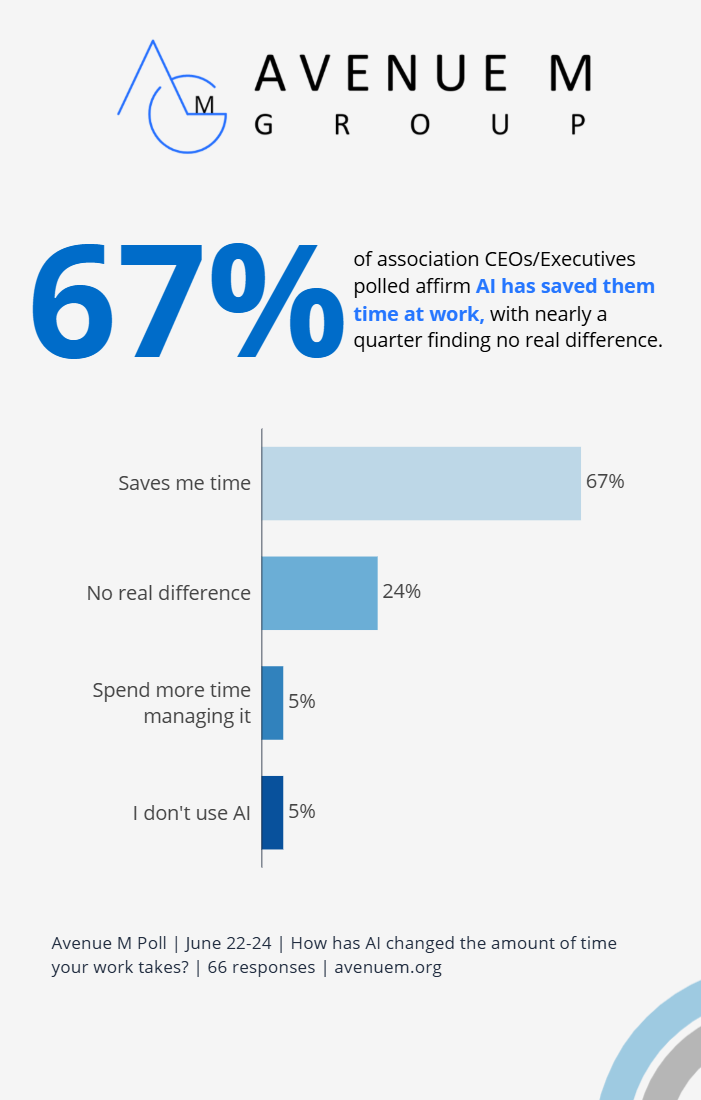
This month, Avenue M asked executives the following question via text poll and LinkedIn:
“How has AI changed the amount of time your work takes?”
The results appeared overwhelmingly positive.
- 67% said AI saves them time.
- 24% said it has made no real difference.
- 5% said they spend more time managing it.
- 5% said they don’t use AI at all.
On the surface, this looks like a clear victory for generative AI in the workplace.
But the written comments told a more nuanced story. And I’m not sure anyone has put a lot of thought into how many additional hours they may be working on something because they need to double check and verify the work being done by AI.
Many executives reported meaningful AI time savings while simultaneously describing fatigue, cognitive overload, and a surprising sense that the work itself feels different.
And that’s where the research gets interesting.
The Hidden Cost of AI Productivity
A 2025 Harvard Business Review study involving more than 3,500 participants found that people produced higher-quality work when collaborating with generative AI. Performance reviews were more thoughtful. Emails were more empathetic. Outputs were generally stronger and completed faster.
But researchers discovered an unexpected tradeoff.
After completing AI-assisted work, participants experienced an 11% drop in intrinsic motivation and a 20% increase in boredom when they returned to tasks without AI support. The tool hands back the minutes while draining some of the energy you bring to whatever comes next. For organizations focused on AI workplace productivity, this is an interesting statistic that could impact future output.
The Two-Thirds Who Are Saving Time
Around two-thirds of respondents said AI saves them time. External research points in the same direction. Goldman Sachs reported in early 2026 that employees with access to enterprise AI tools save between 40 and 60 minutes per day, with many completing tasks they previously couldn’t do at all.
Our respondents described similar experiences. One executive said AI feels: “Energizing because I can do more in less time.” Another described using it to get a head start on presentations and strategic thinking rather than beginning from a blank page. One comment stood out: “Energizing because I have a new friend to help me that gives me unbiased feedback.”
Set aside the word “friend” for a moment. The practical point remains. A thinking partner that is always available, never impatient, and uninvolved in organizational politics is something most leaders didn’t have sitting on their desk two years ago. For many professionals, AI has become exactly that.
The Quarter Who Saw No Difference
Twenty-four percent of respondents from our quick poll said AI has made no meaningful difference in their productivity. That finding is consistent with some of the more cautious research emerging around AI workplace adoption.
A 2026 National Bureau of Economic Research survey of nearly 6,000 senior executives found that 89% reported little or no measurable productivity impact from AI over the previous three years. The Federal Reserve’s most-cited estimate suggests AI users save approximately 5.4% of work hours, roughly two hours per week. Useful? Absolutely. Transformational? Not necessarily.
The difference between “AI saves me time” and “AI hasn’t changed much” may have less to do with the technology itself than what happens to the time it creates. When AI saves an hour and that hour immediately fills with more email, more meetings, or more review work, the stopwatch records a gain even if the calendar never reflects one.
From Creator to Editor
The most revealing comments came from respondents who described feeling mentally exhausted despite saving time. One executive captured the issue perfectly: “What’s happening in those 45-minute rabbit holes is decision fatigue on steroids. When we use AI, our brains shift from creators to editors and overseers.”
That may be one of the most important workplace shifts AI is creating. Historically, much knowledge work involved generating ideas, solving problems, and creating original outputs. AI changes the role. Instead of creating from scratch, we’re increasingly evaluating, correcting, comparing, revising, and selecting from multiple possibilities.
The work becomes less about generating and more about judging.
Although that sounds easier. In many cases, it isn’t.
The 45-Minute Rabbit Hole
Research suggests that supervising AI may be creating a new form of workplace fatigue.
A March 2026 Boston Consulting Group study published in Harvard Business Review described the phenomenon as “AI brain fry”: cognitive overload created by managing and evaluating AI-generated content.
Workers reported mental fog, slower decision-making, increased information overload, and greater fatigue. Researchers found that high-oversight AI work generated:
- 14% more mental effort
- 12% more mental fatigue
- 19% greater information overload
Ironically, the most exhausting use of AI wasn’t letting it work independently. It was closely supervising it. Several respondents described exactly this experience.
One executive observed that the fatigue seems especially pronounced among innovators because AI allows them to move from research to implementation at unprecedented speed. As they put it: “The continual progress is both rewarding and a mental killer.” The speed that creates the productivity gain may also be creating the exhaustion.
The Learning Curve Is Real
Several respondents highlighted another overlooked factor. Some of today’s lost time is simply the cost of learning. One executive explained: “I’m in a deep learning phase, so while I’ve seen some time savings on some tasks, I’m spending a lot of time learning, exploring and testing tools.” That investment is real. Fortunately, it’s also temporary.
Research consistently shows that organizations that invest in AI training capture significantly greater productivity gains than organizations that simply provide access to the tools. The time spent learning today is often what produces the meaningful savings tomorrow.
What Separates the Time-Savers from Everyone Else?
In conversations with leaders over the past year, the executives who consistently realize AI productivity gains without experiencing burnout tend to share four habits.
1. They Use Fewer Tools
They focus on a small, stable set of AI tools rather than constantly chasing new ones. The research suggests that tool-switching often creates more cognitive overload than value.
2. They Decide Where AI Doesn’t Belong
Several respondents drew clear boundaries around human-centered activities. One executive put it simply: “Meeting with staff and stakeholders is an important part of my job, so no AI for now.”
3. They Keep Some Thinking for Themselves
The HBR research suggests that alternating AI-assisted work with cognitively demanding solo work helps preserve engagement and motivation. The leaders who seem most energized by AI aren’t outsourcing all of their thinking. They’re outsourcing selected portions of it.
4. They Protect the Time They Save
This may be the most important habit of all. Saving an hour only matters if that hour gets invested in something valuable. The most successful executives deliberately direct recovered time toward strategic thinking, relationship building, leadership, and innovation rather than allowing it to disappear back into operational work.
What This Means for Your Organization
If your own experience showed up in this month’s survey, three questions are worth asking:
Where does your saved time actually go?
If you can’t clearly identify where recovered hours are being invested, they may not be creating any real advantage.
How much AI oversight are your people performing?
The research suggests oversight load, not automation itself, may be the primary source of AI fatigue.
Which activities have you deliberately kept human?
If you haven’t consciously drawn that line, someone else may be drawing it for you.
The Uncomfortable Truth
The poll tells us that AI is saving time. The comments tell us something more important. AI is very good at reducing the amount of time a task takes. It is far less effective at deciding what should happen with the time it creates. That’s still leadership. The organizations that benefit most from AI won’t be the ones that automate the most work. They’ll be the ones that make the best decisions about what work should remain human.
AI can save an hour. It cannot decide what that hour is worth.
Additional Resources
“Research: Gen AI Makes People More Productive—and Less Motivated“ (Harvard Business Review, 2025). The research behind the motivation and boredom findings discussed above.
“AI Brain Fry: Managing Cognitive Overload in the Age of Artificial Intelligence“ (Harvard Business Review, 2026). A deeper look at the cognitive fatigue associated with supervising AI-generated work.
The Unexpected Power of Boundaries (Amplify, 2026). Why constraints, not unlimited options, are often the key to sustained performance, innovation, and engagement.
Want to be the first to be notified about articles like this? You can learn more about Avenue M’s texting poll service HERE or sign up to participate in future text polls HERE.
Contributors: Sheri Jacobs, FASAE, CAE and Claude.ai
Image: Sheri Jacobs