

Avenue M asked a question that hits closer to home than most executives are willing to admit, via a text poll and on LinkedIn the week of May 18, 2026: “Most of your week is spent…” The answers, taken together, tell a story that should worry every leader.
Here’s what we learned:
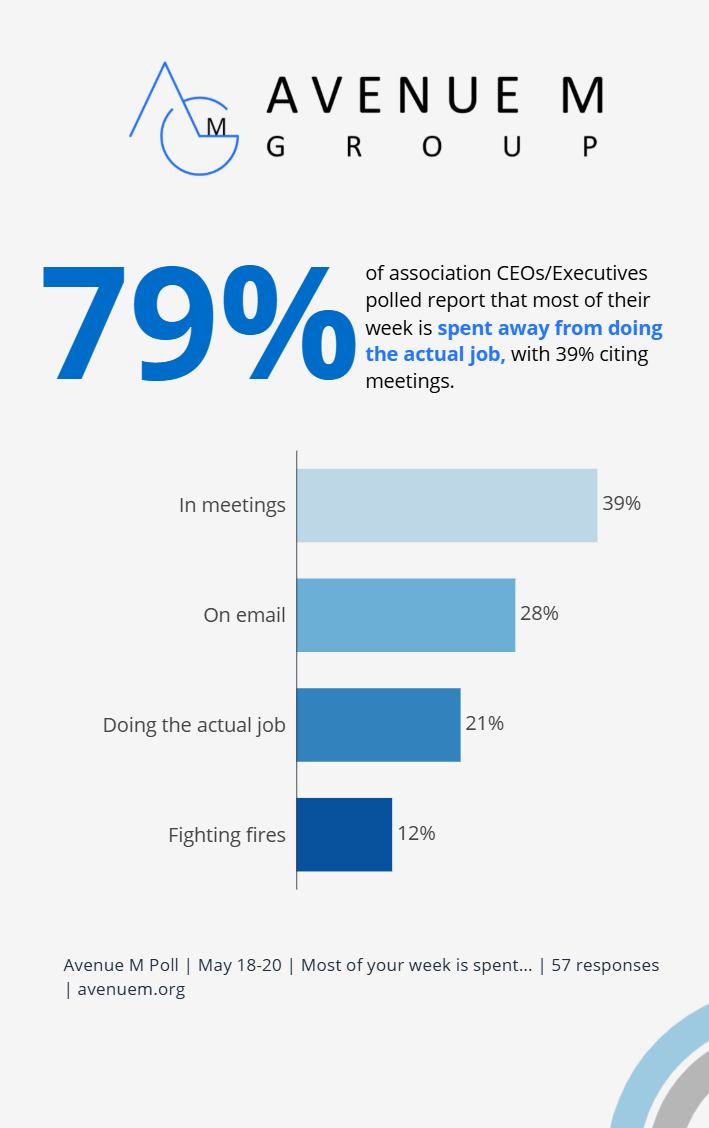
39% (22) said they spend most of their week in meetings, 28% (16) said on email, 21% (12) said doing the actual job, and 12% (7) said fighting fires.
When you add this up, nearly 80% of respondents say most of their week is spent on something other than the work they were hired to do. Only about one in five is actually doing the job.
The Meeting Majority
The largest group, 39%, said meetings consume most of the week. That number tracks with the broader data. Harvard Business Review research has found that executives now spend nearly 23 hours a week in meetings, up from less than 10 hours in the 1960s. The volume isn’t the only problem. An HBR Executive Playbook published in November 2025 put a sharper point on it: instead of tackling the organization’s most important strategic choices, executive meetings too often devolve into performative report-outs, riddled with lengthy slide decks and updates that members could have provided asynchronously.
The trouble isn’t meetings. It’s what they’ve replaced. Meetings used to be where decisions got made. Now they’re often where decisions get delayed, restated, or deferred to the next meeting. When the people calling them admit they’ve become slide-deck theater, the issue isn’t calendar management. It’s that no one has the authority, or the willingness, to push back.
The Email Trap
Almost three in ten executives said email defines the week. McKinsey Global Institute research, still cited as the benchmark in 2026, finds that knowledge workers spend 28% of their workweek, roughly 11 hours, managing email. Executives are not exempt. They are usually at the top of the distribution. See these 2026 email statistics from Readless for more details.
The Firefighter Tax
Twelve percent said fighting fires takes up most of their week. On the surface, this is the smallest group. But fires almost never travel alone. They bleed into the meetings, take over the inbox, and crowd out the actual work. The same HBR analysis noted earlier observed that executive meetings often turn into firefighting sessions, focused on immediate operational issues. The fires aren’t just outside the calendar. They’re inside it, eating the time that was supposed to be for strategy.
The deeper problem is what fires reveal. A constant fire-fighting state usually points to something structural: unclear decision rights, missing systems, a senior team that hasn’t learned to operate without the CEO in the room. When the same fires keep showing up, the fire isn’t the real problem. The fact that it keeps catching is.
The 21% Who Do the Work
The most interesting group isn’t the largest. It’s the 21% who said they spend most of the week doing the actual job. That number should be higher in an industry built on expertise. What are those executives doing differently?
In my conversations with CEOs over the last year, the ones who land in the 21% almost always share three habits.
- They protect calendar territory. Not soft blocks for “focus time” that get moved when someone more senior asks. Hard, recurring, non-negotiable blocks for the work only they can do.
- They have a senior team that runs meetings without them. The CEO isn’t the default attendee. Their absence is treated as a signal of trust, not a problem to solve.
- They have clear decision rights. People know what to bring to the CEO and what to handle. When this is fuzzy, that’s when every decision becomes a meeting.
Where AI Could Help
We asked a follow-up question: where could AI actually help? The responses revealed both pragmatic optimism and useful skepticism.
The most common answer was meetings. “AI can help with pre-reads, context, note taking and identifying action items,” one respondent wrote. “The key is for humans to commit to pre-work, roles, responsibilities and moving forward once decisions are made.” That last sentence matters more than the first. AI can compress the prep and the recap. It can’t make the team show up ready to decide. Another executive described the day-to-day rescue: “Meeting summaries are very helpful in outlining action items to keep everyone on track. Then you can write a prompt to make a to-do list with deadlines. It’s a real saver when you are back to back.”
One answer stood out from the rest, because it used AI on the structural problem rather than the surface symptoms. “I am currently using AI in Asana to evaluate where I am spending my time against our goals, project deliverables and time spent supporting staff,” one executive wrote. “I expect to realign delegation and whether I need to be in a meeting versus supporting my staff behind the scenes.” Most executives are pointing AI towards automating their existing work. This one is pointing it towards redesigning it.
Others mentioned analysis and drafting. “AI does help in analysis, professionalizing my responses, and overall as a thought partner,” one respondent noted. Another listed “summarizing the salient points from email, meeting notes, etc. and constructing reports.”
But not every executive is convinced. “I consider meeting with staff and stakeholders an important part of my job so no AI for now,” one wrote. Another answered the question with two words: “Not at all.” That skepticism deserves a hearing. The relationships built in meetings and the trust that comes from someone actually being present are not problems AI is designed to solve. The risk is using efficiency tools to remove the friction that was actually doing the work.
AI can compress the time you spend on the wrong things. It can’t decide what the right things are. That’s still leadership.
What This Means for Your Organization
If you saw your workweek in this poll, here are three honest questions worth sitting with.
- What percentage of your meetings would survive a zero-based calendar review? If you canceled them all today and only added back the ones that clearly produce a decision, an alignment, or a relationship that matters, how many would come back?
- What does your email actually represent? If it’s mostly internal questions, your team needs more decision authority. If it’s mostly external, your communications team may need more. Either way, the inbox is a symptom.
- Where would the work that only you can do show up on your calendar this week? If you can’t point to it, it isn’t happening.
The Uncomfortable Truth
Only 22% said they’re doing the actual job. That’s not a productivity problem. It’s a design problem. Calendars, inboxes, and reporting lines were built for a world with less information, fewer channels, and slower cycles. Most of us are running 2026 organizations on 2005 operating habits.
Boundaries don’t slow leaders down. Their absence does.
Additional Resources
“Conducting an Effective Executive Team Meeting” (HBR Executive Playbook, November 2025). Practical framework for turning C-suite meetings from box-checking into decision-making. Useful diagnostic if your meetings have started feeling like report-outs.
“If We’re All So Busy, Why Isn’t Anything Getting Done?” (McKinsey, 2022). Still one of the clearest pieces on why collaboration tools haven’t translated into faster execution. The framing of “real-time virtual interaction” versus “value-creating collaboration” is worth borrowing.
The Unexpected Power of Boundaries (Amplify, 2026). For more on how the highest-performing leaders use constraints to expand what they’re capable of, rather than treating limits as the enemy.
Want to be the first to be notified about articles like this? You can learn more about Avenue M’s texting poll service HERE or sign up to participate in future text polls HERE.
Contributors: Sheri Jacobs, FASAE, CAE
Image: Sheri Jacobs